
Now Live: Bulgari Octo Finissimo Tadao Ando Limited Edition, Ref. 103245, Sandblasted Titanium
Now live: a Bulgari Octo Finissimo Tadao Ando Limited Edition, ref. 103245, in sandblasted titanium. Created with the celebrated Japanese architect an...


Gérald Genta really did sketch the Royal Oak overnight. He just did not do it alone, he did not choose the size, he did not pick the name, and for most of his career nobody outside the industry knew who he was. The story of how one man became the signature on the most influential watch design of the twentieth century.
At four o’clock one afternoon in April 1970, Georges Golay, managing director of Audemars Piguet, telephoned a thirty-eight-year-old freelance designer in Geneva and asked for a steel sports watch that had never been done before, waterproof, by the following morning.
Genta told that story for the rest of his life, in almost identical words, and Audemars Piguet’s own archives repeat it. It is not a myth. What has been built on top of it mostly is.
Gérald Charles Genta was born in Geneva on 1 May 1931, to a Swiss mother and an Italian father. He did not train as a watchmaker. He trained as a jeweller and goldsmith, earning his Swiss federal diploma around 1951, at twenty.
This matters more than any other biographical fact about him. Genta came to watches from metalwork and ornament rather than from movements and escapements, and it shows in everything he made. His signature move, repeated across four decades and half a dozen brands, was to take a case and a bracelet and treat them as a single continuous piece of jewellery rather than as a housing bolted to a strap. The integrated bracelet is not a styling flourish in his work. It is the whole idea.
Universal Genève hired him young. In 1954, at twenty-three, he designed the Polerouter, originally called the Polarouter, made to mark Scandinavian Airlines’ new polar route from Copenhagen to Los Angeles over the North Pole. It is a tiny watch by modern standards with a twisted lug profile and a micro-rotor movement, and it remains one of the most quietly influential designs of the 1950s. He was twenty-three and he had already done the thing he would keep doing.
Genta worked with Universal into the 1960s and then went out on his own, which in the Swiss industry of that era meant something closer to a contract draughtsman than to an author. He reworked the Omega Constellation. He designed the Rolex King Midas, an asymmetric solid gold slab that remains one of the strangest things Rolex has ever put its name on. He took work from Cartier, Van Cleef & Arpels, Chaumet, Bulgari, Hamilton, Seiko, Timex.
In 1969 he founded a company under his own name to make high complication pieces for private clients, which is worth noting because it means that by the time Golay called him, Genta was already trying to be a brand rather than a supplier.
He later claimed to have created more than a hundred thousand watch designs over his career. Take the number for what it is, a designer late in life describing the scale of a working practice rather than counting anything. But it tells you the shape of the job. He was producing volume, for hire, mostly uncredited, for whoever was buying.
Here is the part the overnight story leaves out.
On 10 April 1970, just before the Basel Fair, Golay met with three of his agents: Carlo de Marchi for Italy, Charles Bauty for Switzerland, and Charles Dorot for France. They are remembered in the AP archives as the three musketeers. They pressed Golay on whether gold was still the only signifier of prestige, and they asked for a luxurious, modern steel sports watch, refined enough to wear in the evening.
The Royal Oak was not an idea that arrived from a designer’s imagination. It was a market brief from three salesmen who could see something their principal could not. Golay took the risk. Genta executed it. The insight belonged to the distribution network.
Genta’s own account, given repeatedly and consistently, is that he understood Golay to be asking for a new waterproofing technology, and that he answered it by inverting the logic of a diver’s helmet.
On a scaphandre helmet, the bolts and the gasket are on the outside, visible, doing their job in plain sight. Genta put eight hexagonal screws through the bezel and left the water resistance gasket exposed at the edge of the case. The watch shows you how it is sealed. That is the entire conceptual content of the design, and everything else, the octagon, the tapisserie dial, the tapering bracelet, follows from committing to it.
Where he saw the helmet is where the record gets soft. His widow has said it was divers he watched as a boy on Lake Geneva. Other accounts put it at the coast. Audemars Piguet’s official telling just says a diver’s helmet and leaves the location out. Nobody has documentation, and a story retold across forty years of interviews acquires detail whether or not the detail was ever there.
He delivered sketches the next morning. The watch reached market at Basel in 1972. Between those two points is where the Royal Oak was actually made, and almost none of it was Genta.
The first prototypes were built in white gold, because machining high-grade steel to the tolerances the design demanded was too difficult and too expensive to justify for prototypes. Steel had to be worked like a precious metal, with brushed surfaces and polished chamfers on every angle including the flanks of the bracelet, and the industry had no established process for doing that at this level. Gay Frères in Geneva built the bracelet, reference 344, with 154 components across dozens of sizes, tapering from about 25.9mm at the case to about 15.9mm at the clasp. It was notoriously hard to produce.
And then there is the size, which is the detail that most cleanly falsifies the lone-genius reading.
The Royal Oak is 39mm at a moment when men’s watches were 35 or 36mm. Collectors nicknamed it the Jumbo, and the market has spent fifty years treating that scale as Genta’s bold statement about wrist presence. Audemars Piguet’s own heritage department says otherwise. The eight screws pass all the way through the monocoque case and the oversized seal. They could not pass through the movement, so they had to go around it, and with a 28mm calibre inside, the case had to grow to accommodate the screws at its periphery. AP notes that Genta’s own later testimonies never claim he wanted a large watch. The size was a consequence of the construction, not an intention. Function produced the proportion, and the proportion produced the legend.
Genta did file a US patent, number 3,756,017, so his authorship of the construction is a matter of public record. But the watch that shipped was the output of a manufacture solving problems for two years.
By September 1971 the watch still had no name. The candidates on the table included Safari, Colorado, Kilimanjaro, Grand Prix, Diane, Surfrider, Canyon, Oxford, Ascot and Yale.
Royal Oak first appears in the archives in December 1971, credited to Carlo de Marchi, the Italian agent who had helped ask for the watch in the first place. The reference is to the Royal Navy ships of that name, of which there were eight, which in turn take their name from the oak tree that hid Charles II from Cromwell’s troops after the Battle of Worcester in 1651.
So the most valuable name in modern watchmaking was chosen by an Italian distributor, twenty months after the design existed, from a shortlist that also contained Ascot and Yale.
It launched at Basel in 1972 at something in the region of 3,300 to 3,750 Swiss francs, depending on which source you trust, which made it the most expensive steel watch anyone had made and put it well above gold watches from serious houses. The trade thought it was absurd. The first A-series ran to roughly two thousand pieces across two batches between 1972 and 1975, with the AP monogram at six o’clock rather than twelve, and it took years to sell through. Genta himself said it was about three years before the design took hold, and that the Italians understood it first.
The 5402 stayed in the catalogue until 1989. The watch that saved Audemars Piguet took most of a decade to stop looking like the thing that might sink it.
The Royal Oak made Genta a name, and the name became the product.
Patek Philippe came to him and got the Nautilus in 1976. IWC got the Ingenieur SL the same year. Bulgari got the Bulgari Bulgari in 1977, a watch that put the brand’s name on the bezel and turned a jeweller into a watch house. He kept building his own brand through the 1980s and 1990s, making Grande Sonnerie and retrograde pieces of real complexity, and sold it to Bulgari in 2000. He painted seriously in his later years. He died on 17 August 2011, aged eighty.
The most human moment in the whole story comes in 1993, when Audemars Piguet launched the Royal Oak Offshore, designed by Emmanuel Gueit, at 42mm. Genta, according to Gueit, came into the booth at Basel furious that his Royal Oak had been destroyed, and called the new watch a sea elephant. He was sixty-two, and he was arguing about a watch he had sketched in one night twenty-three years earlier, for a fee, on someone else’s brief.
Before Genta, watch design was anonymous house work. Cases and dials were drawn by staff or by contractors, and no buyer ever asked whose pen it was. Genta did that job for twenty years without a byline.
What changed is not that he became a better designer. What changed is that the market discovered it wanted an author. A watch with a named designer behind it can be discussed as authored work rather than as product, and authored work carries a premium that product does not. By the time Genta died, his name on a design was worth more than most brands’ entire back catalogues, and every serious house had learned to name its designers.
That is the actual legacy, and it is bigger than any single watch. The Royal Oak is the object where the industry learned that the drawing could be worth more than the mechanism.
Which is worth remembering when you look at what a steel Audemars Piguet costs today. You are not paying for the calibre. You are paying for a decision made in one night in 1970, executed over two years by people whose names nobody records, sold under a title chosen by a salesman in Milan.
Continue reading
Now live: a Bulgari Octo Finissimo Tadao Ando Limited Edition, ref. 103245, in sandblasted titanium. Created with the celebrated Japanese architect an...
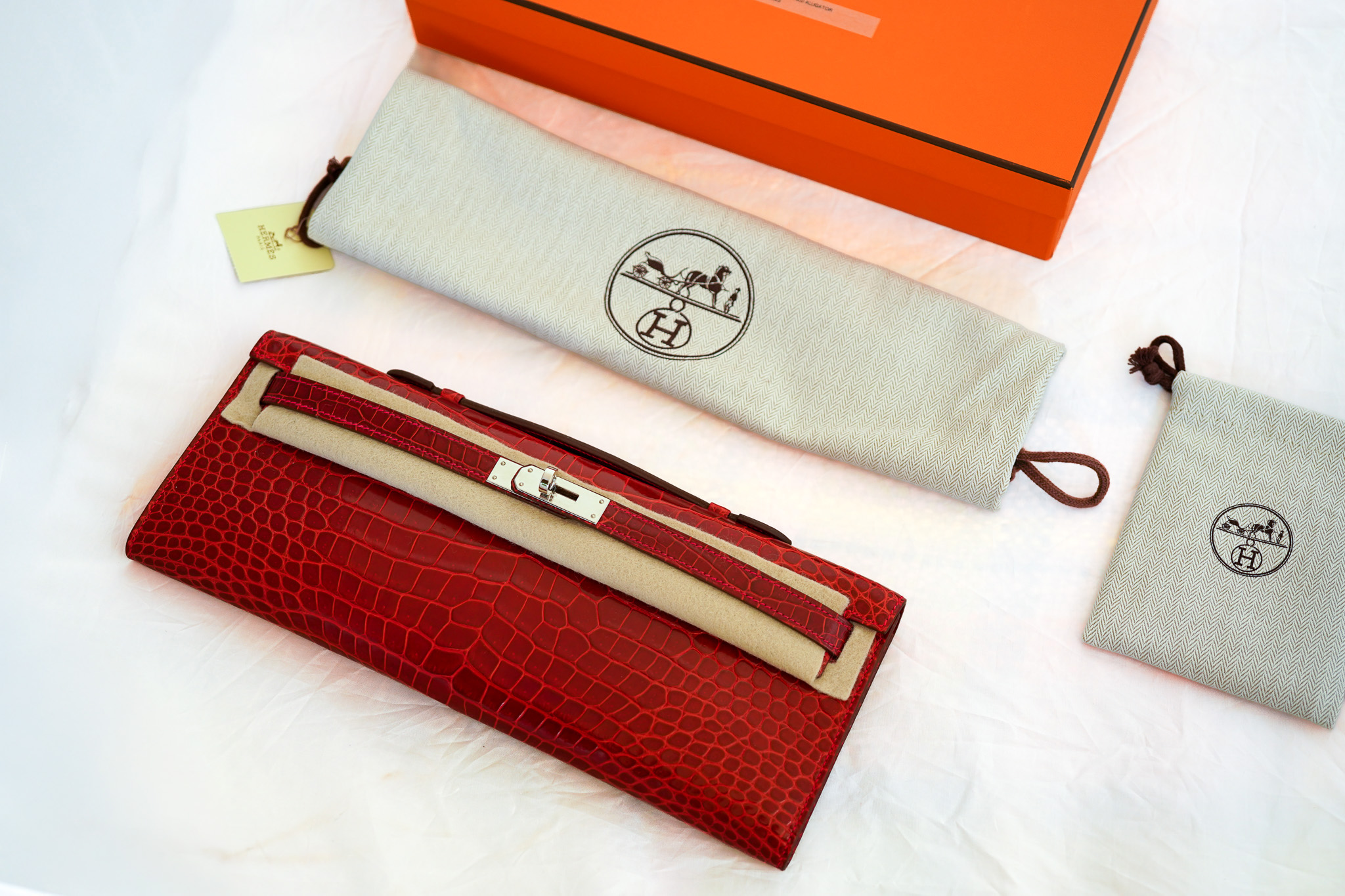
Now live: a 2023 Hermès Kelly Cut in shiny Rose Sheherazade alligator with palladium hardware, unworn and complete with its box, dust bags and tag. Th...
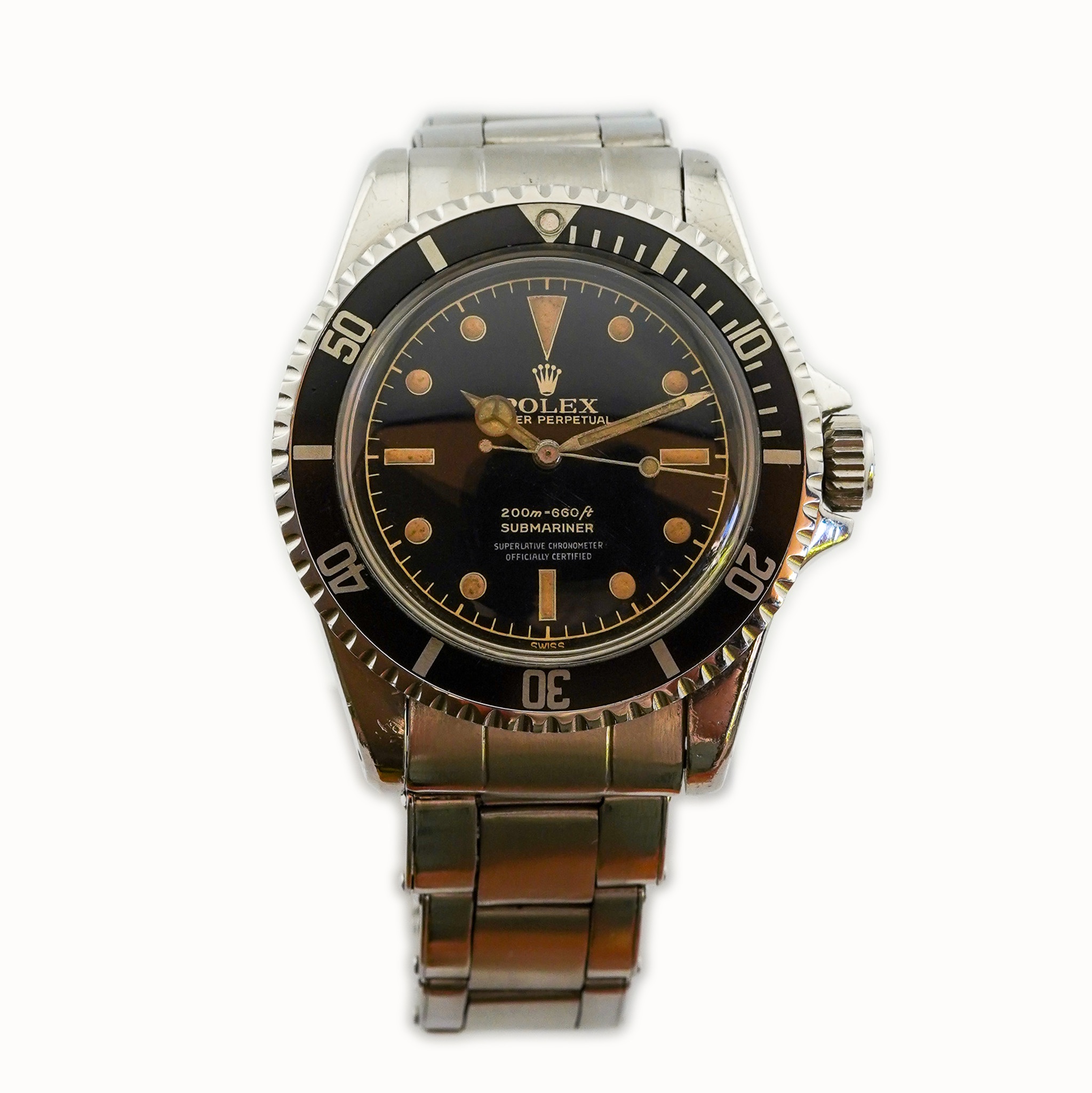
In 1962 the same case, the same bezel, the same bracelet, and the same hands went into two references. The only thing separating them on the wrist was...